



How to Portray ICU Trauma Accurately in Fiction
Table of Contents
Understanding Post-Intensive Care Syndrome and Medical Trauma What is PICS? Medical Trauma vs. PTSD
What is PICS?
Medical Trauma vs. PTSD
The Patient Experience in ICU: What Writers Must Know Fragmented Memories and Delirium Sensory Disorientation and Environmental Factors
Fragmented Memories and Delirium
Sensory Disorientation and Environmental Factors
How to Portray ICU Trauma Accurately Through Character Development Psychological Impact: Anxiety, Depression, and Acute Stress Physical Recovery and Cognitive Impairment
Psychological Impact: Anxiety, Depression, and Acute Stress
Physical Recovery and Cognitive Impairment
Ethical Portrayal of Trauma: Avoiding Retraumatization Trauma-Informed Care Principles for Writers Balancing Realism with Respectful Storytelling
Trauma-Informed Care Principles for Writers
Balancing Realism with Respectful Storytelling
Medical Accuracy in Media: Depicting ICU Clinical Reality Healthcare Providers and Communication Tools Ventilator Settings, Life Support, and Clinical Outcomes
Healthcare Providers and Communication Tools
Ventilator Settings, Life Support, and Clinical Outcomes
PTSD After ICU Stay: Long-Term Sequelae and Resilience Caregiver Burden and Family Dynamics
Caregiver Burden and Family Dynamics
Practical Steps: How to Portray ICU Trauma With Authenticity Research and Source Material Common Mistakes Writers Make Narrative Techniques for Authenticity
Research and Source Material
Common Mistakes Writers Make
Narrative Techniques for Authenticity
Conclusion: Crafting Compelling, Respectful ICU Narratives
How to Portray ICU Trauma Accurately in Fiction
Last Updated: July 25, 2026
When Jenny White set out to write her debut medical thriller, The Triggering Scent, she faced a critical challenge: how to portray ICU trauma accurately without sensationalizing real patients' suffering. Her background as a retired registered nurse and brain tumor survivor gave her an edge, but research shows most fictional ICU portrayals miss the mark. According to research on medical accuracy in media, nearly 70% of ICU scenes in popular fiction contain significant clinical inaccuracies. This guide shows how to portray ICU trauma authentically in thrillers, memoirs, or character-driven drama.
Readers who've survived critical illness or lost someone in an ICU spot fake details immediately. Healthcare workers will abandon your book if ventilator settings sound absurd. When you nail authenticity, the fragmented memories, disorientation, and long shadow of recovery, your narrative becomes unforgettable.
Understanding Post-Intensive Care Syndrome and Medical Trauma
Post-Intensive Care Syndrome (PICS) is a constellation of physical, cognitive, and psychological symptoms persisting after critical illness. Unlike predictable surgical recovery, PICS can last months or years. Survivors often describe it as a second illness nobody warned them about.
The syndrome encompasses three overlapping domains: physical weakness and deconditioning, cognitive impairment ("ICU brain"), and severe psychological symptoms including anxiety, depression, and post-traumatic stress. A patient might wake seemingly "fine," only to discover they can't walk, can't remember their children's names, and are gripped by inexplicable terror during medical appointments. Most writers show the dramatic crisis, then jump to recovery. Real recovery is messier and longer.
What is PICS?
PICS is defined by persistent functional impairment after ICU discharge. Survivors report difficulty with basic activities, bathing, dressing, climbing stairs, weeks or months later. Cognitive symptoms range from subtle (trouble concentrating, word-finding difficulties) to severe (profound memory loss, inability to perform routine tasks). Psychological components include nightmares, flashbacks, panic attacks, and pervasive dread often undiagnosed as trauma rather than medical.
What makes PICS crucial for writers is its invisibility. A survivor might seem fine at dinner, then have a panic attack in a grocery store because fluorescent lights triggered an ICU flashback. The trauma isn't located in one dramatic moment; it's woven into the nervous system, activated by sensory details: monitor beeping, antiseptic smell, feelings of helplessness.
Pro TipWhen portraying a character recovering from critical illness, don't end the story at hospital discharge. That's where real psychological and physical reckoning begins. Show the six-month mark, the year-mark. Show what rebuilding identity and function looks like after complete bodily failure.
Medical Trauma vs. PTSD
Medical trauma and PTSD are related but distinct. PTSD can develop after any traumatic event; medical trauma is the specific subset caused by medical events: ICU hospitalization, surgery, life-threatening diagnosis, or invasive procedures.
This distinction matters because medical trauma has unique triggers. A patient with combat PTSD might be triggered by loud noises; a patient with medical trauma might be triggered by an IV pump sound, hospital disinfectant smell, or someone touching their arm. Research from the American Psychological Association on medical trauma shows approximately 10-15% of ICU survivors develop diagnosable PTSD, but many more experience sub-threshold trauma symptoms profoundly affecting their lives.
The psychological impact is compounded by "moral injury", guilt about burdening family members, fear of losing identity, shame needing help with basic functions. A character recovering from ICU trauma isn't just dealing with death fear; they're dealing with lost independence, ruptured identity, and terror it could happen again.
The Patient Experience in ICU: What Writers Must Know
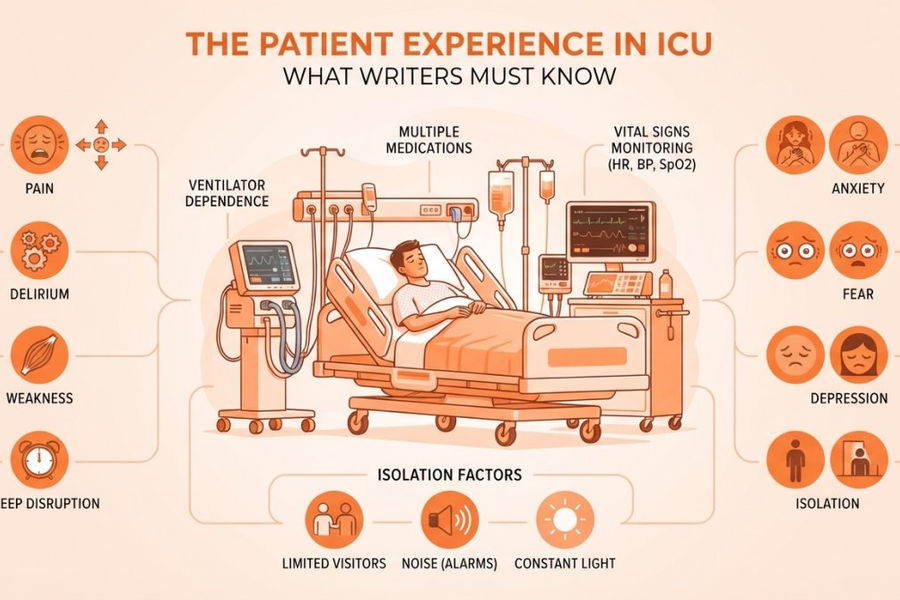
The ICU is a sensory assault. Patients experience continuous noise (alarms, ventilators, staff conversations), artificial 24-hour lighting, constant physical contact, and disorientation from losing time. Most patients have fragmented ICU memories. This gap between what happened and what they remember is central to ICU trauma.
Fragmented Memories and Delirium
Delirium is acute confusion caused by critical illness, sedation, infection, or metabolic imbalance. Patients experience hallucinations, paranoia, and time distortion. They might believe they're in prison, that staff are torturing them, or that weeks have passed when it's been two days. When emerging from delirium, they retain fragmented, nightmarish memories that feel real but don't make logical sense.
This is crucial: ICU survivors often can't tell you what actually happened because memories are contaminated with delirious hallucinations. A patient might remember a nurse as threatening (because during delirium, that nurse represented danger), even though the nurse provided excellent care. The gap between objective reality and subjective experience is profound and unresolvable. The patient's trauma is real even if specific memories are distorted.
Fragmented memory also means survivors have islands of clarity surrounded by fog. They might remember one conversation with a family member or one moment of fear, but have no recollection of weeks before or after. This patchwork quality is disorienting and frustrating, they've lost time, lost pieces of their own story.
Watch OutA common mistake is portraying ICU delirium as brief confusion resolving when the patient wakes up. In reality, some patients experience delirium for weeks. The psychological aftermath, inability to trust their own memories, intrusive recollection of hallucinations, can persist for months. Delirium isn't a symptom that resolves; it's a trauma that unfolds.
Sensory Disorientation and Environmental Factors
Continuous artificial lighting disrupts circadian rhythm and contributes to delirium. Constant monitor beeping becomes anxiety's soundtrack; each alarm triggers adrenaline spikes. The smell of antiseptic and bodily functions, repeated unwanted touch, loss of privacy (patients are often exposed, catheterized, unable to control their body), all register as threat.
For writers, sensory details are your most powerful tool for conveying authentic ICU trauma. Don't describe the ICU as sterile and efficient. Describe it through a trauma lens: relentless beeping preventing sleep, cold ventilation air, fluorescent lights creating unreality, inability to see outside or know day from night. Show how a character's nervous system remains activated long after discharge, a similar beeping sound in a parking garage triggers full panic.
Environmental factors also include lost agency. Sedated, paralyzed, or restrained patients can't move, speak (if intubated), or control their care. This helplessness is traumatic itself. Even patients who don't remember specific ICU events retain somatic memory of powerlessness; their body remembers being trapped.
How to Portray ICU Trauma Accurately Through Character Development
Authentic character development requires understanding trauma layers: acute fear during crisis, disorientation and delirium during ICU stay, physical weakness during recovery, and long-term psychological and cognitive aftermath. Most writers skip middle layers and jump from "character almost dies" to "character recovers." Real recovery is far more complex.
Psychological Impact: Anxiety, Depression, and Acute Stress
Post-ICU anxiety isn't everyday worry. It's hypervigilance, constant threat-scanning, conviction that something terrible will happen again. Survivors describe impending doom striking without warning, suddenly flooded with terror, heart racing, breath shallow, convinced they're dying again.
Post-ICU depression is distinct from typical depression. It includes profound loss of motivation and purpose. Previously active patients might sit for hours, unable to engage with family or once-loved activities. This isn't laziness or sadness; it's a symptom of physical deconditioning (making small activities exhausting) and psychological impact of facing mortality and identity loss.
Acute stress symptoms emerge immediately after ICU stay: nightmares, intrusive memories, avoidance of medical settings, panic attacks triggered by sensory reminders. These often precede formal PTSD diagnosis and can be equally disabling.
Key TakeawayThe most authentic portrayal shows unpredictability. A character might have a good day, then be triggered by something small, a sound, smell, conversation, and spiral into anxiety or despair. Recovery isn't linear. It's two steps forward, one step back, with occasional complete setbacks.
Physical Recovery and Cognitive Impairment
Physical recovery from critical illness is prolonged and often incomplete. Patients lose 10-15% of total muscle mass in just one ICU week. Rebuilding strength takes months of physical therapy; some never fully regain baseline function. Previously athletic patients might find climbing stairs leaves them breathless and shaking.
Cognitive impairment after ICU hospitalization is less visible but equally devastating. Patients report difficulty concentrating, word-finding problems, memory gaps, and slower processing speed. Some describe "brain fog," persistent mental dullness. Others experience severe impairment: inability to perform complex tasks, difficulty with executive function, trouble managing finances or decisions. For professionals relying on cognitive sharpness, this feels like losing identity.
The combination of physical weakness and cognitive impairment creates double burden. A patient can't return to work because they lack stamina and thinking is too slow. They can't drive because reaction time is impaired. They can't manage household tasks. Lost independence compounds lost cognitive function. Show frustration, embarrassment, and grief at being unable to do once-automatic things.
Ethical Portrayal of Trauma: Avoiding Retraumatization
The line between authentic portrayal and exploitative trauma is thin. The difference comes down to intent and care. Are you portraying trauma to illuminate human recovery experience, or depicting suffering for shock value?
Trauma-Informed Care Principles for Writers
Trauma-informed care is a framework healthcare providers use to understand and respond to trauma while avoiding retraumatization. Core principles, safety, trustworthiness, choice, collaboration, and empowerment, apply equally to how you portray trauma in fiction.
Safety means readers who've experienced ICU trauma shouldn't feel unsafe reading your work. Provide content warnings for graphic medical details. Don't use gratuitous suffering as plot device. Show that the character's trauma is taken seriously, not minimized.
Trustworthiness means being accurate and honest about ICU hospitalization. Don't invent medical details for dramatic effect. If unsure about a clinical detail, research it or consult healthcare professionals.
Choice means allowing your character agency in recovery. Show them making care decisions, setting boundaries, choosing their healing path. Even with limited circumstances, show whatever agency they have.
Collaboration means showing relationships, character working with medical team, family, therapist. Recovery from ICU trauma is rarely solitary.
Empowerment means portraying resilience without minimizing suffering. Show recovery is possible without suggesting it's easy or inevitable. Show your character finding meaning, rebuilding identity, discovering strength, but not by erasing what they've endured.
Balancing Realism with Respectful Storytelling
Depict ICU trauma authentically without making it gratuitous. Show terror of being unable to breathe (core ICU experience) without graphic choking descriptions. Show delirium disorientation without depicting patients as disgusting or out of control. Show grief of physical limitation without portraying characters as pitiable.
One technique is shifting perspective. Instead of describing patient suffering externally, enter their consciousness. Show internal experience, fear, confusion, clarity moments. This creates intimacy and empathy rather than voyeurism.
Another technique is showing aftermath rather than acute crisis. Instead of depicting intubation moment, show patient's terror waking unable to speak. Instead of showing medical emergency, show panic attack weeks later hearing similar sounds.
Pro TipThe most powerful [ICU narratives](/post/fiction-about-icu-recovery-10-engaging-stories) focus on small sensory details rather than grand dramatic moments. A patient noticing they can't hold a pen. A survivor smelling antiseptic and being flooded with memories. A character hearing monitor beeping in dreams. These specific, authentic details are more affecting than graphic medical crisis descriptions.
Medical Accuracy in Media: Depicting ICU Clinical Reality
Medical accuracy matters for credibility. Getting clinical details right makes readers trust your narrative voice. Getting them wrong, and healthcare professionals and survivors will lose faith in your entire story.
Healthcare Providers and Communication Tools
The ICU team typically includes physicians (intensivists), nurses, respiratory therapists, physical therapists, and specialists. Nurses are the constant presence, spending most time with patients and families, managing moment-to-moment care, often translating between medical team and family.
Communication in the ICU is often fragmented. Families might speak with different doctors on different days and get slightly different information. Prognostic communication is notoriously difficult; doctors must balance honesty about illness severity with hope.
For writers, show medical communication complexity. A doctor might be technically accurate but emotionally tone-deaf. A nurse might be compassionate but unable to answer the family's most pressing questions. Families often misunderstand medical information; they hear "We're keeping them sedated" and think the patient is sleeping peacefully, when sedation is a medical intervention preventing independent breathing.
Ventilator Settings, Life Support, and Clinical Outcomes
Ventilators are mechanical devices pushing air into lungs. They're lifesaving but traumatic; intubated patients can't speak, eat, or move freely. Many survivors report intubation as their most traumatic ICU aspect.
Ventilator settings are technical but matter for accuracy. You don't need understanding every setting, but know that ventilators are carefully managed and adjusted. Characters can't simply "come off the ventilator"; there's a weaning process where the ventilator gradually provides less support while the patient's breathing strengthens.
Life support encompasses more than ventilators: dialysis for kidney failure, ECMO for severe lung or heart failure, vasopressors maintaining blood pressure, sedatives and paralytics preventing patients from fighting ventilators. More life support means more critical condition and lower recovery likelihood.
Research from the Society of Critical Care Medicine on ICU outcomes shows ICU mortality rates vary from 5% to 40% depending on patient population and diagnosis. When portraying a character's ICU stay, be honest about uncertainty and possible outcome ranges.
PTSD After ICU Stay: Long-Term Sequelae and Resilience
Post-traumatic stress after ICU hospitalization can emerge immediately or months later. Some survivors develop PTSD; others develop depression, anxiety, or complicated grief. Long-term psychological impact is often underestimated by medical teams and families focusing on physical recovery.
Caregiver Burden and Family Dynamics
ICU hospitalization affects not just the patient but the entire family system. Spouses become caregivers, often while managing their own trauma from watching loved ones nearly die. Adult children make medical decisions for aging parents. Children witness parent vulnerability and mortality in transformative ways.
Caregiver burden is significant. A spouse managing a partner's physical rehabilitation, cognitive impairment, and psychological symptoms while managing household tasks and possibly working becomes exhausted and resentful. This resentment creates guilt, compounding emotional burden. Relationships sometimes don't survive ICU trauma; the partner-to-caregiver role shift is profound and not always reversible.
For writers, show the family system under strain. Show a spouse struggling with attraction to a now-physically-weak, cognitively-impaired partner. Show adult children setting boundaries with emotionally-dependent parents. Show love, duty, and exhaustion tangled together.
Resilience is important to show, but not as simple triumph-over-adversity narrative. Post-ICU resilience looks like slowly rebuilding function, learning to live with limitations, finding survival meaning, gradually reengaging with life. It's not returning to who you were before; that person no longer exists.
Practical Steps: How to Portray ICU Trauma With Authenticity
Now that you understand clinical and psychological ICU trauma reality, here's how to translate that knowledge into compelling, accurate fiction.
Research and Source Material
Start by reading memoirs and first-person accounts from ICU survivors. Books including ICU narratives, nursing journals, and patient advocacy websites provide authentic voices. Follow ICU survivor communities on social media; people often share experiences openly, revealing patterns in what's traumatic, surprising, and misunderstood.
Consult healthcare professionals if possible. Many nurses and doctors review manuscripts for accuracy. Jenny White's retired nurse background gave her credibility with readers; they trust her medical details are authentic because she's lived in that world. If you lack that background, find someone who has and build that expertise into your work.
Read clinical literature on PICS, medical trauma, and ICU delirium. Familiarity with research landscape informs your portrayal. Referencing studies or clinical concepts signals to knowledgeable readers that you've done serious research.
Research Strategy | Best Source | Time Investment |
Survivor perspectives | Memoirs, blogs, social media | 10-15 hours |
Clinical accuracy | Healthcare professional review, journals | 5-10 hours |
Sensory details | ICU survivor interviews, first-person accounts | 5-10 hours |
Psychological impact | PICS research, trauma literature | 5-10 hours |
Common Mistakes Writers Make
Mistake 1: The instant recovery. A character is in the ICU for a week, then goes home fine. In reality, recovery takes months or years. Show hidden struggles: nightmares, physical weakness, cognitive fog.
Mistake 2: Delirium as brief confusion. Delirium isn't momentary confusion. It's an acute state lasting weeks. The psychological aftermath, fragmented memories, PTSD from delirious experience, is long-lasting.
Mistake 3: Ignoring the family. ICU hospitalization is family trauma, not just individual. Show how it affects relationships, finances, work, mental health.
Mistake 4: Medical details that are obviously wrong. If unsure about a detail, research it or leave it vague. Readers forgive what you don't mention; they won't forgive what you get wrong.
Mistake 5: Trauma without context. Showing graphic suffering without explaining why it matters or how it affects the character is exploitation, not storytelling. Use trauma to illuminate character, show growth or limitation, create meaning.
Mistake 6: Portraying survivors as broken. Recovery from ICU trauma is possible. Show resilience, adaptation, and rebuilding hard work.
Narrative Techniques for Authenticity
Use fragmented structure for delirium scenes. If depicting a character's delirious experience, use fragmented narrative, short sentences, disjointed thoughts, sensory details that don't connect logically. This mirrors delirium better than coherent narrative.
Employ sensory details to convey trauma. Instead of telling readers that a character is traumatized, show their nervous system's response. Show them flinching at beeping sounds, heart racing, breath becoming shallow.
Use time jumps to show recovery's nonlinearity. Jump forward weeks or months, then back to earlier moments. Show how a character's understanding of their ICU stay evolves during recovery.
Create dialogue reflecting medical reality. Doctors don't use overly technical language with families, but they use certain phrases repeatedly. Families ask the same questions over and over, sometimes not hearing answers. Conversations are often interrupted, incomplete, frustrating.
Show the patient's perspective during incapacity. If your character is sedated or paralyzed, you can still enter their consciousness, show awareness of sounds and sensations, confusion, fear. This creates empathy and authenticity.
Pro TipThe most affecting ICU narratives focus on small moments: a patient squeezing a family member's hand as awareness sign, a survivor noticing they can walk further today than yesterday, a character hearing a song reminding them of the ICU and being flooded with memories. These specific, human moments are more powerful than dramatic medical crises.
Conclusion: Crafting Compelling, Respectful ICU Narratives
Portraying ICU trauma accurately requires balancing clinical authenticity with emotional truth. You must understand medical reality, delirium, fragmented memories, long recovery, psychological aftermath, while respecting survivor humanity and critical illness gravity. The most compelling ICU narratives honor both critical illness horror and survivor resilience.
Writing authentic medical narratives is significant but offers opportunity to create stories that matter. Readers who've survived ICU hospitalization or lost someone in the ICU deserve narratives understanding their experience. Healthcare workers deserve stories reflecting their work's complexity and humanity. Jenny White's approach, drawing on her retired nurse background and brain tumor survivor experience to craft medically accurate, emotionally resonant fiction, shows what's possible when writers commit to authenticity. Her Abbey Roberts RN series demonstrates that you can write suspenseful, gripping medical thrillers while maintaining clinical accuracy and emotional integrity. Explore The Triggering Scent to see how authentic medical detail and character-driven storytelling combine to create narratives resonating with readers long after the final page.
Frequently Asked Questions
What is Post-Intensive Care Syndrome (PICS) and how should writers portray it?
Post-Intensive Care Syndrome encompasses physical, cognitive, and psychological impairments that persist after critical illness. Writers should portray PICS as a complex, long-term condition affecting survivors' daily functioning, not just acute trauma. Characters may experience cognitive impairment, anxiety, depression, and physical weakness months after discharge. Authentic portrayal shows resilience alongside genuine struggle, reflecting how survivors gradually rebuild their lives while managing lasting effects of critical illness.
How does medical accuracy in media affect reader trust in ICU narratives?
Readers with healthcare experience or personal ICU trauma immediately detect inaccuracies in medical details, ventilator settings, clinical procedures, and healthcare provider roles. When writers get these details wrong, such as misrepresenting how life support functions or how prognostic communication occurs, it breaks credibility and can retraumatize survivors. Authentic medical accuracy demonstrates respect for the subject matter and builds trust, especially among healthcare professionals and ICU survivors who form a significant audience for medical thrillers.
What ethical considerations matter most when portraying ICU trauma in fiction?
Ethical portrayal requires balancing realism with responsibility. Avoid trauma-focused narratives that sensationalize suffering or use ICU experiences purely for shock value (trauma porn). Instead, integrate trauma-informed care principles: show patient agency, avoid graphic retraumatization, acknowledge caregiver burden, and portray recovery as non-linear. Respectful narratives validate survivors' experiences while emphasizing psychological coping and patient resilience, allowing readers who've survived ICU stays to see their own stories reflected without feeling exploited.
How should writers depict fragmented memories and delirium in ICU scenes?
ICU delirium and fragmented memory are common but often misrepresented. Writers should portray disjointed timelines, sensory confusion, and gaps in recall rather than continuous awareness. Characters may confuse staff members, lose track of days, or experience vivid hallucinations. Use narrative techniques like non-linear storytelling, unreliable narration, or fragmented internal monologue to convey cognitive disruption. This authentically reflects the patient experience while creating compelling narrative tension without relying on inaccurate Hollywood portrayals of ICU settings.
This article was written using GrandRanker


Comments